
If there’s one place where history lingers, it’s Portsmouth Historic Dockyard. A place of legends, home to mighty warships like HMS Warrior and the Mary Rose. But some ships hold more than just history.

Today, I took a day off, drove down to Portsmouth, and met with two friends. The sun was shining, the sea breeze carried the scent of salt and tar, and the day promised nothing but adventure. But what started as a fascinating glimpse into naval history took a turn I wasn’t expecting—a cold, eerie shift aboard HMS Victory—Lord Nelson’s legendary flagship from the Battle of Trafalgar.
Stepping Back in Time at the Portsmouth Historic Dockyard
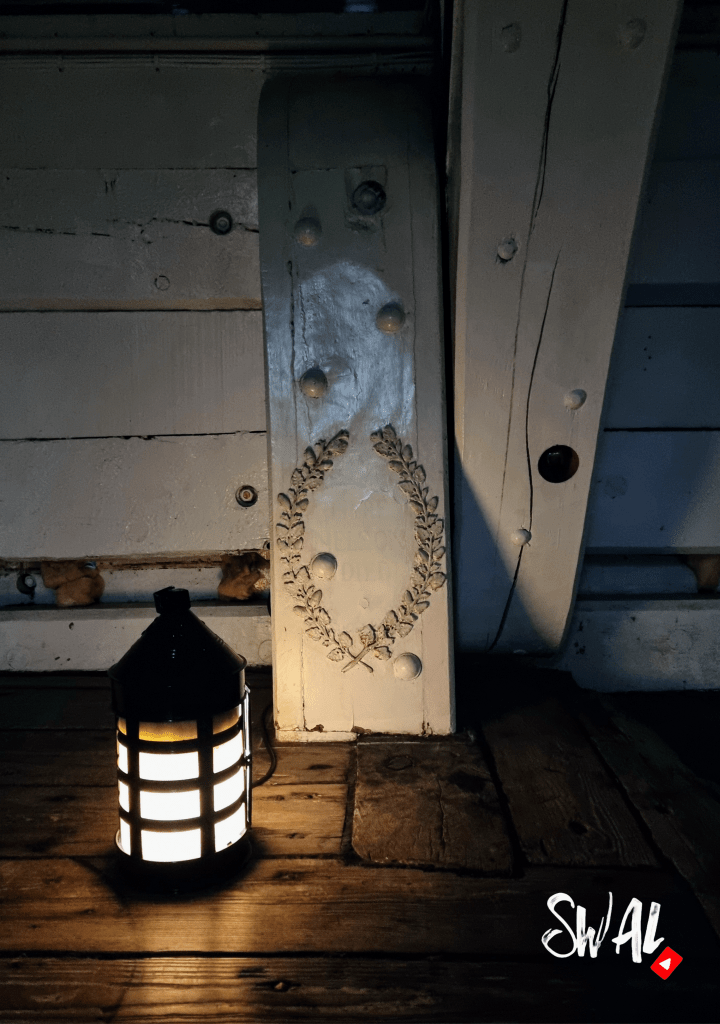
Walking onto the majestic ship, you feel its age press down on you. The wooden planks creak underfoot, the low ceilings feel almost oppressive, and the air is thick with the scent of tar, paint, and rope. Dim candle-like lighting casts shadows that seem to move on their own.
The gun decks are lined with massive cannons, and I couldn’t help but imagine the chaos of battle—800+ sailors crammed into this space – eating there, sleeping there, fighting there – and deafened by the roar of gunfire, the thick smoke choking the air, and the screams of wounded men. This ship has absorbed violence, victory, and loss—a place that has seen both triumph and tragedy.
Lord Nelson and HMS Victory
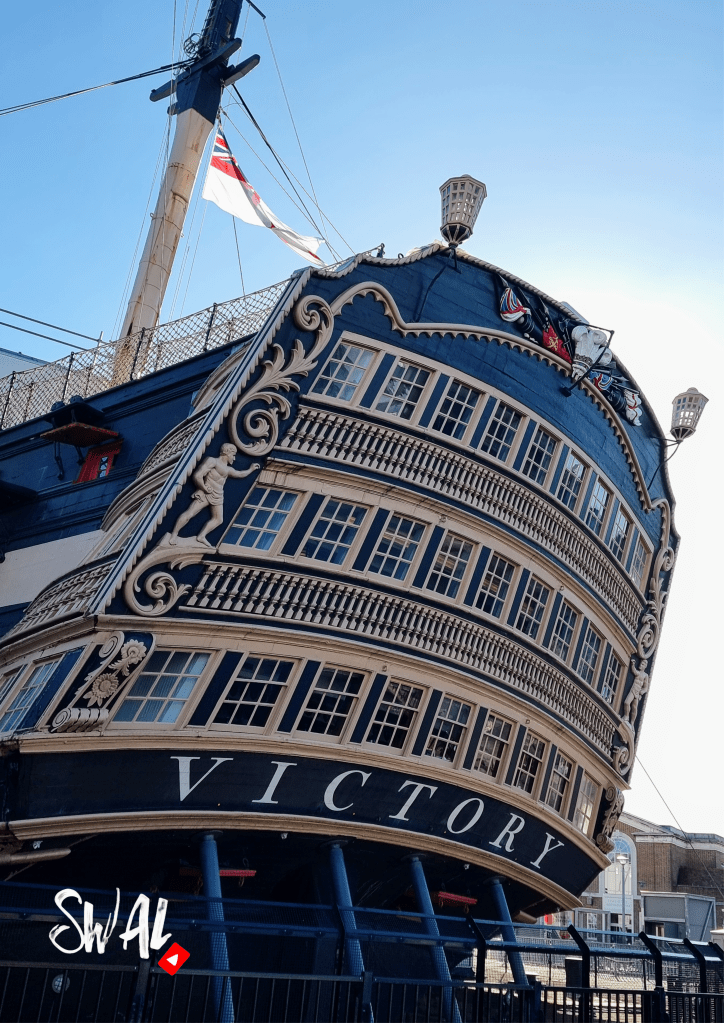
HMS Victory has seen its share of battles since her launch in 1765, but she is best remembered for her role in the Battle of Trafalgar on 21st October 1805. Under the command of Vice-Admiral Horatio Nelson, she led the British fleet into battle against the combined forces of France and Spain.
At the time, Napoleon Bonaparte was preparing to invade Britain. Economic warfare, political power and retaliation for naval superiority were at the core of Napoleon’s planned invasion. Britain was the biggest obstacle to his domination of Europe, he needed control of the seas, but the British Royal Navy stood in his way.
Napoleon ordered his fleet, along with Spain’s, to break Britain’s naval dominance, clear the English Channel, and pave the way for an invasion. However, the British, under Vice-Admiral Horatio Nelson, intercepted the enemy fleet off the coast of Cape Trafalgar, Spain.
Nelson, aboard HMS Victory, used an unorthodox strategy—he divided his fleet into two columns and sailed directly into the enemy line, cutting it apart. This broke the enemy’s formation, causing confusion and allowing the British ships to engage at close range. Though outnumbered (27 British Ships vs 33 French & Spanish,) the superior training and gunnery of the Royal Navy overwhelmed the French and Spanish forces and secured a decisive victory.
But…. the price was steep.
During the battle, Nelson was shot by a French sniper from the Redoutable while standing on the quarterdeck.
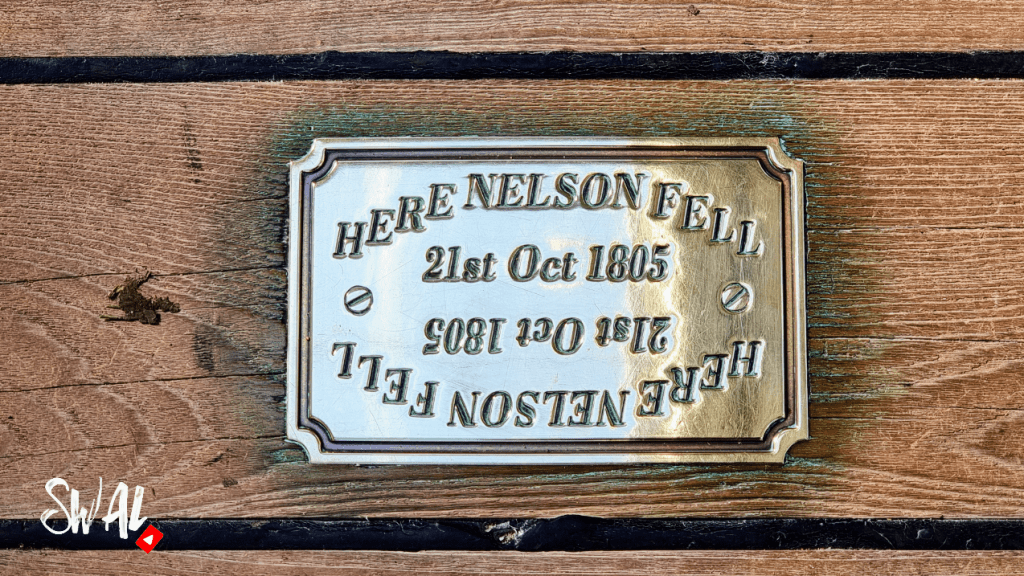
He collapsed, mortally wounded, and was carried below to the orlop deck. As the battle raged on above him, he lay dying, his final words whispered through labored breaths:
“Now I am satisfied. Thank God I have done my duty.“

At 4:30 PM, he passed away. His body was preserved in a barrel of brandy for the journey home, and he was laid to rest in St. Paul’s Cathedral, a national hero immortalized in history.
But some say he never truly left his ship.
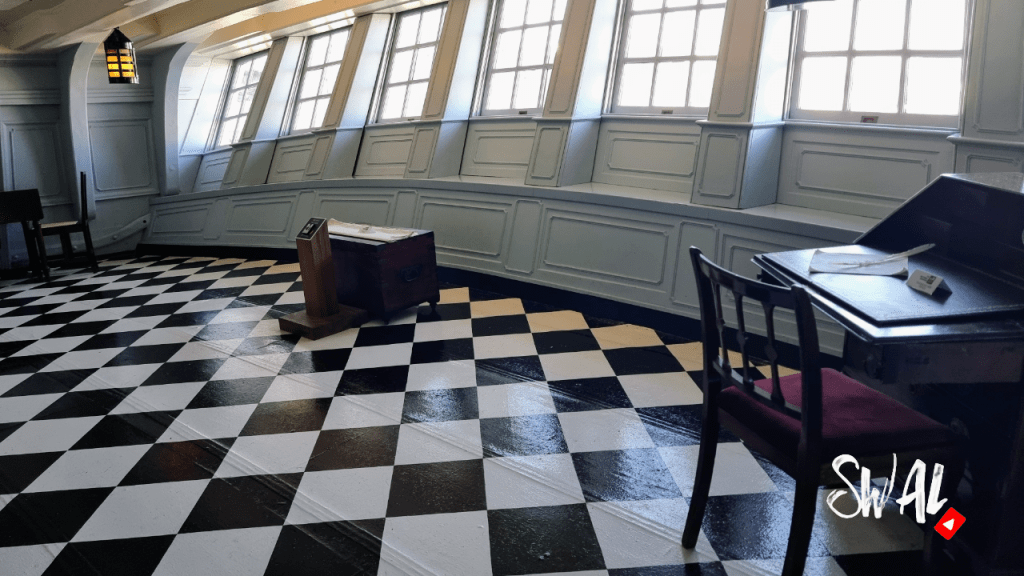
I walked through Nelson’s quarters, running my fingers along the fine woodwork, standing in the very place where he took his last breaths. The ship feels both alive and empty, as if it holds its breath, waiting. It’s a monument to heroism, but also a graveyard—a relic of war.
Little did I know, I was about to have a strange experience of my own.
A Chilling Presence on the Lower Deck
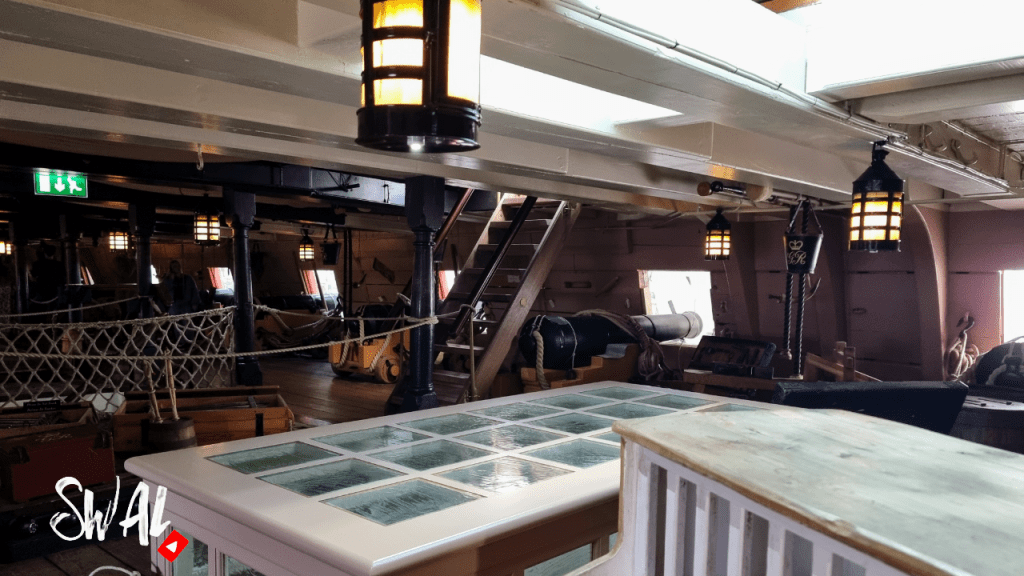
It happened below deck, in the exact spot where I took this photo.
A sudden pressure gripped my chest. It was sharp and heavy, like an invisible weight pressing down on me. I gasped, struggling for breath. It only lasted a moment, but it sent a jolt of fear through me. The last time I felt anything like it was in one of Edinburgh’s infamous vaults. But that’s a story for another day.
I shook it off, convincing myself it was just my imagination. But then, something else happened.
As I moved toward one of the cannons, with my two friends beside me, we noticed something strange—one of the heavy gun tackles was moving on its own.
We stood still, watching the thick rope sway. We checked for drafts, an open window, anything that could explain it. My friend touched the one next to it—it stopped immediately. I reached out and stopped the moving rope with my hand, three times. For a moment, all was quiet.
Then, as soon as I let go, it began to move again.
Who Still Walks the Decks?
HMS Victory has long been rumored to be haunted. Some say Nelson himself, and his wife, walk the decks, never leaving his beloved ship. Others believe the spirits of the sailors who fought and died aboard still linger, bound to it in death as they were in life.
The gun decks, in particular, are said to be a hotspot for ghostly activity. Could I have stumbled upon one of them? We explored other parts of the ship, found more of these tackles—but none of them were moving.
A trick of the air? Or was something unseen still at work on HMS Victory, tending to their duties as they had centuries ago?
One thing is certain—HMS Victory is more than a museum. It’s a time capsule, a legend, and perhaps, a home for the restless spirits of the past.
What Do You Believe?
Have you ever experienced something unexplainable at a historic site? Do share your stories in the comments—I’d love to hear them!
 Sam Walks a Lot